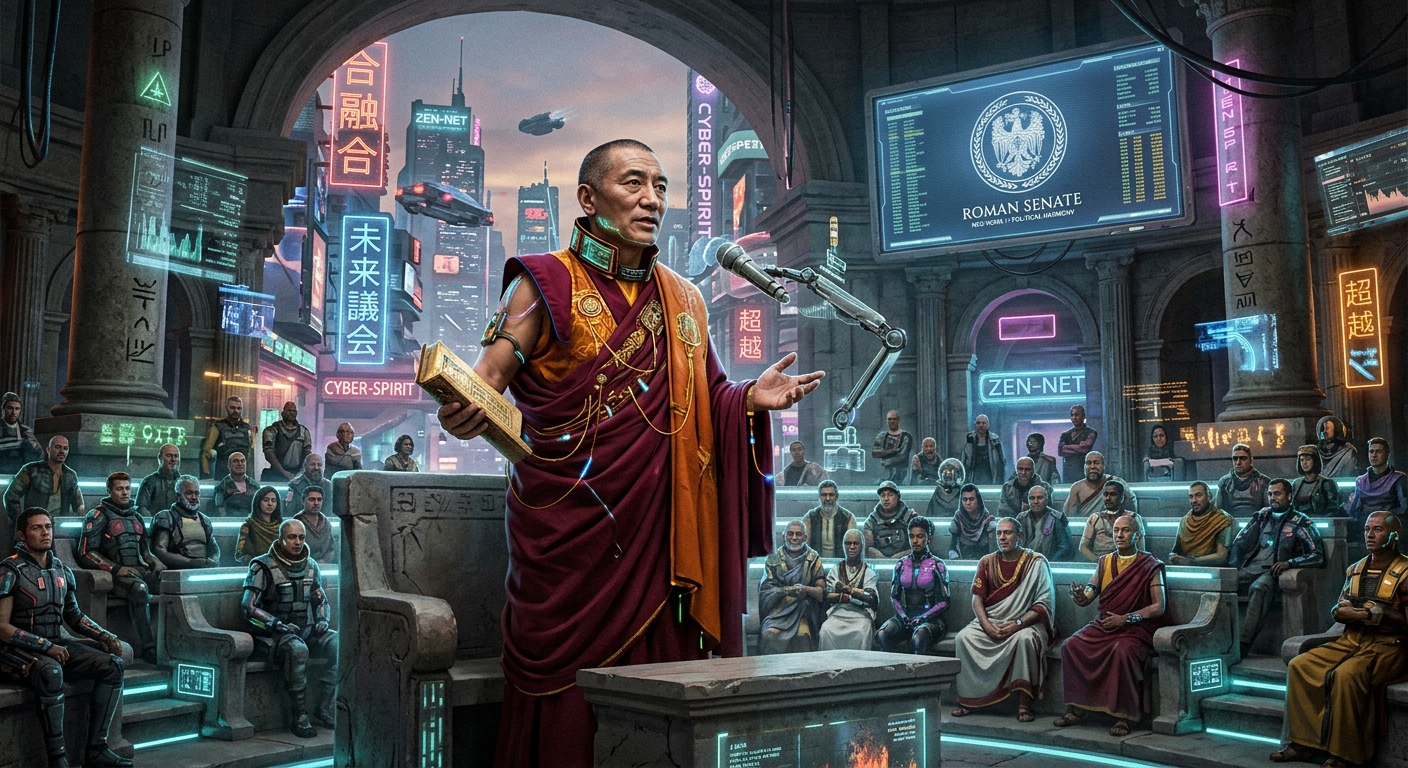
Politics + Spirituality + Technology = Evolution
In Venezuela we don’t ask: “What does politics have to do with spirituality and technology?” In Venezuela we would say (to put it nicely): “What does the sphincter have to do with the eyelashes?”
Still, after taking a few minutes to reflect and think, I did find a connection between these three areas of knowledge that seem so far apart, and that is what this post is about.
It’s inevitable: you get home, see that the place is a mess, and think: where do I even start?
In a country with a political landscape as disordered and polarized as Venezuela’s, it’s inevitable to take at least a few minutes and think: if I were president, where would I start to clean up this mess?
Of course, someone without the slightest notion of what practicing politics means could take actions that, instead of improving things for everyone, would make them worse.
It already happened in Mao’s China with the “Great Leap Forward,” and we know what happens when someone with no knowledge of a given field makes decisions in an area as vital to society as agriculture. We also know what happens when a military man wants to stick his nose into economic matters… it doesn’t end well at all.
Therefore, the first thing I should do before even thinking about proposing solutions is, at a minimum, read the manual on how political science and public administration work.
Politics
My entry point in this area is the book Introducción a las doctrinas político-económicas (Introduction to Political-Economic Doctrines) by Walter Montenegro. I don’t know his nationality, but I know he was a Bolivian lawyer, writer, and diplomat, so I infer he is from Bolivia.
It’s a fairly impartial read, bordering on academic, that gave me a good initial understanding of the broad political spectrum, from the most socially accepted currents, like democracy, to the most individualistic and radical ones, like anarchism, also passing through the different shades and variants of socialism.
Something that caught my attention is that the author understood the subject well enough to call each of these political-economic currents into question, as when he asks: “Is the opinion of the majority always the most accurate?” or “Should the vote of someone well versed in a subject carry the same weight as that of someone who knows absolutely nothing about it?” These are critical questions directly tied to democracy.
And needless to say, there are the currents that stir up both passion and irrational fanaticism, like Marxism and communism (spoiler alert: they are not the same thing), or the different variants of socialism.
As a critique, it is mentioned that, within the communist current, society lives in a constant process of material dialectics, or, put plainly: those who have fight with those who have less over power and control of society’s rules, and the rise of the latter over the former is inevitable.
The bourgeoisie displaced the monarchs, and the people displaced the bourgeoisie (at least according to communist ideology), but one question was left open: once the last link in the chain takes power, then what?
Marx didn’t have the answer to this question because, in his time, it hadn’t happened yet.
Today, October 27, 2026, the answer is already here: from the political power of the proletariat emerges a new social class that places itself (in perceived exercise of power) above the masses.
And the material dialectic process happens again in a new cycle.
In Venezuela, colloquially, they are called “los enchufados” (the well-connected). I don’t know what people in Cuba, Nicaragua, or, in its day, the Soviet Union called those who held power.
The book, although a bit outdated regarding current political events (just imagine, it still talks about the Soviet Union as if it were alive, so it was written before 1991, when the Berlin Wall fell), presents a fairly complete overview of what is timeless, which is political doctrine.
Spirituality
Yesterday I was talking with my cousin about how one should allow oneself to live the most diverse experiences, in the most different areas, without prejudice, and how from this process of lived experience the synthesis of new and better perspectives would emerge.
Hegel, the philosopher, already spoke about this as a dialectical process of ideas. That’s right, that fancy-sounding term shows up again, only the meaning is slightly different.
Appealing once again to plain language: you have an idea, you contrast it with something totally opposite, and from the points in common a synthesis is born, a new idea that takes the best of both worlds.
I think that when Hegel talked about the dialectical process, he was talking about contrasting ideas that are at least related in context.
I went a bit further by contrasting things that have nothing to do with each other, at least in perception.
And I talk about spirituality because it seems to me to be the glue that binds all ideas together, by allowing you to consciously observe the world around you and yourself.
Observing, that is the key here: you can’t wipe the soot off your face if you don’t know it’s there. You must, necessarily, see your reflection.
There are common points across all religions, at least the ones I have allowed myself to explore superficially so far.
One of them is love in practice, which has nothing to do with the sexual act.
I mean recognizing each and every being in this world as a living being just like you, and acting in a way that makes life a little better for those in need.
Perhaps just offering a glass of water to the thirsty, listening to the troubled, or practicing good politics so that society, and all of us who live in it, are a little better off.
Just as there are similarities, there are also differences. I would say the most radical one is the way and the place where we look for answers.
For Westerners (a current I belong to only because of geography), the answers come from looking outward, toward an external person, a stranger to us, who will guide us down the right path: a pastor, a messiah, a priest, a rabbi, and sometimes it even overlaps with the identity of the politician, as in the case of an ayatollah.
For Easterners, the answers come from within, from a meditative and reflective process (sometimes with the help of a teacher or guru, though it isn’t mandatory) that will inevitably lead you to a better understanding of the world, of things, and of yourself.
As an experiment, it would be good for you to take some time to try both currents in a practical way and without prejudice, if you haven’t done so before.
Maybe you will find something new that makes you see the world in a different way.
As an anecdote: how do you know you don’t like fish if you haven’t allowed yourself to try it without prejudice?… I didn’t eat fish.
Technology
Ahh, technology: hand in hand with the hard sciences in the engineer’s work.
That abstract world that many people find hard to understand, because it seems to be written in a strange dialect, like Mandarin Chinese is for us Westerners.
How does it fit into this whole mishmash? If we were working in the fields, politics would be the way we divide up the labor: you, my friend, plow this part; I’ll plow that side; and the rest of you take care of planting.
Spirituality, as I mentioned, and in simplified terms, is for me the act of observing consciously and making decisions based on what I see.
I would say: “Gentlemen, we are not going to plow today because it looks like a downpour is coming.” I saw it, I analyzed it, and I made a coherent decision about it.
Technology is the set of tools we work with to do the job faster and better.
I could plow with oxen, sure, but why not do it better with a tractor? That is technology.
And for me, right now it plays a key role because we are in the middle of a technological transformation similar, if not exactly the same, to the one experienced with the birth of the steam engine, which set the Industrial Revolution in motion, except that today we call it “Chat-G-P-T.”
Never before was knowledge so easy and accessible for all of humanity. If you are reading this, you most likely have a computer or a phone, and, like the farmer who uses a tractor to do his work faster and more efficiently, it is our job to understand technology and get the most out of it.
I must issue an important warning about the use of artificial intelligence: it should not be seen as a replacement for the cognitive process, but as a complement that helps me think and obtain information in a way that is easier, faster, and more digestible.
The tractor still needs a driver to guide it; don’t expect the field to plow itself perfectly by the grace of the Holy Spirit.
And if that is how you think, I have bad and alarming news for you: somewhere in the world there is someone letting AI do all their homework without even reading it. It could be your future doctor.
You’d better start eating healthy and exercising.
The Convergence
In very few words, this is the meeting point:
we must use tools (technology) consciously (spirituality) to improve the rules of the environment we live in (politics).
I could end this post right here, but let’s talk a little more about it.
It seems to me that the only constant in life is change. Many things happen, sometimes similar but with certain nuances.
Paraphrasing Charles Darwin:
the species that prevails is the one that adapts to change and evolves.
Evolution is the counterpoint to politics: there is nothing more rigid in society than the way society itself is structured.
Consider that the primary reference works were written by the Greeks and reinforced by the Romans in law, and today, in essence, the way we legislate and make laws is still done in almost the same way.
What does constantly evolve is society, and its laws, especially to make it more equal.
200 years ago, the school of liberalism, with the ideas of Adam Smith, prevailed as the main economic ideology within the British Empire, and mentioning Marx’s work was considered sacrilege.
It’s curious that Marx developed a good part of his thinking while living in Great Britain as a bourgeois, but perhaps the context of that nineteenth-century England where Marx lived was the perfect ecosystem for good questions to emerge: why is the rich man rich and the poor man barely able to survive?
In this England, at the dawn of the Industrial Revolution, some very heavy things were happening: children working from the age of 4, and even younger; women and men working side by side in conditions that to call precarious would be almost a decorative understatement, in shifts of 16 hours or more, in exchange for maybe 3 coins to buy half a loaf of hard bread.
Life was truly hard, and those conditions gave rise to communist thought.
Today, the ideas as Marx conceived them are obsolete; they have no place in a society where social security, 40 to 44 hour work weeks (and under study to become shorter still), legal minimum wage, paid vacations, and unions are the standard in all democratic countries, but the critique kept its promise of change in society.
And the countries with the best quality of life are those that carried this evolutionary process forward by integrating social policies into democratic thinking, such as the Nordic countries, some European ones, and even the United Kingdom itself, which was once the embodiment of the capitalist ideal and today holds a social-democratic stance.
People speak (sometimes disparagingly) of a bourgeois society in these countries, which enjoy an improved quality of life, historically speaking, but isn’t that the ultimate goal of politics in society: to make all the citizens of the polis, as they were called in ancient Greece, live in the best possible way and in harmony?
The Case of Latin America
It’s a mistake to fall into the thinking of “if they did it in Europe, we can do it too.”
Whoever says that hasn’t understood the idiosyncrasy of Latin Americans, since European culture is characterized by being quite rigid, organized, introspective, and cold, in the good sense of the word.
I don’t know if the climate has anything to do with it; it seems so, because the further south you go, the more Latin things get.
Toward the north, where it’s colder, everything feels more structured and organized than in countries further south, like Italy and Spain.
And it also happens within Latin America: Argentina has a colder, more European vibe than warmer countries like Venezuela, Colombia, and Cuba, just to name a few.
So we can’t do politics the European way; we have to do politics the Latin American way, where family values, celebration, and human warmth are the law. And here I can allow myself to think: if I were president, what would I do?
We must leverage new technologies, such as artificial intelligence, automation, and robotics, to bring about change in society.
Not in an imposed way but an organic one: holding fairs, events, and parties that foster curiosity about using these tools.
Create friendly policies to attract digital nomads with a strong focus on technology, and encourage their integration into communities through social events.
Infrastructure investment should go primarily toward developing basic services such as water, electricity, and connectivity… Yes, the internet today has become a basic service.
On-site work should be optional for jobs that can be done remotely, such as office work, for example.
During the oil boom, Arturo Uslar Pietri said his famous phrase: “we must sow the oil.” Today I would say: “we must connect the oil.”
In terms of education, I think a reform in how some university degrees work is necessary today, where showing what you know is worth more than the certificate you receive when you finish the program.
Nowadays, I think the structure of universities is designed to reward whoever can memorize more over whoever can think, and the student’s goal becomes chasing a piece of paper rather than the act of understanding. That’s why the policy of classroom debate would be, for me, a better option: no exams, no evaluations, no degrees, no rewards, just the desire to learn.
Of course, so as not to repeat Mao’s mistakes, as I said at the beginning, this shouldn’t be an absolute rule. Careers like medicine, dentistry, and some branches of engineering, such as civil, are exempt from this reform. You wouldn’t put your life in the hands of a doctor without a degree, would you?
When it comes to professional licensing, I would give guilds a bigger role. Want to practice education? Sign up with the educators’ guild and earn, through hands-on fieldwork, the right to be called a licensed educator.
The further the fields of application of technology, the more disruptive the changes.
Sometimes I have fantasized about an artificial intelligence agent being present in courtrooms to take notes and summarize what was said. I use it daily in my work meetings, so why not make the job easier for judges and lawyers too?
But just imagine: if courts keep working exactly the same way as in Roman times, the problem with this kind of novelty is not the technology itself, but the struggle with our own prejudices and dogmas as a society.
And I don’t blame us, honestly, because the way society works comes from thinking: “if something sort of works, DON’T TOUCH IT! Don’t even think about looking at it.”
And so we find ourselves struggling in the dichotomy of our own human essence: we dream, we long for change as the promise of getting something better, but changing hurts, and changing the way we think hurts even more.
And this is where spirituality enters the narrative: we must observe these dogmas, our own dogmas, to allow ourselves to change, do things differently, and evolve.
And if along the way we find that the new path was worse than where we came from, no problem: we change again, but never backward, as an endless iterative process.
Big tech companies like Google and Meta have a work philosophy with their employees: “we expect you to fail, and to do it as fast as possible so you can learn as fast as possible too.”
If the biggest companies in the world have a philosophy that sounds like it came out of the most sacred books of Buddhism, why not apply it ourselves too? What is the paradigm holding us back?
So, my dear and charming reader, if you made it to the end of this blog, first I want to thank you for taking the time to read. In times when attention comes in videos of no more than 20 seconds, reading with intention is an arduous task.
Second, you have homework:
-
Mrk, stop asking ChatGPT, Gemini, or any other AI tool to do your homework. READ and, more importantly, THINK.
-
Take time to disconnect: turn off your phone for a while, stop watching TikToks or reels of people who don’t know you exist and don’t care about your existence, and spend time with the people who DO care about you: maybe your dad, your mom, your partner, your siblings, your friends, I don’t know. Even if you live alone, you are not as alone as you think. There are people who think of you and you matter to them.
-
Take time to think, to use your gray matter. I’m saying it twice because thinking is that important: not only to learn, but to examine your own dogmas and paradigms and take action to change yourself.
-
Artificial intelligence and technology in general are powerful tools: learn to use them to bring about change in society.
-
Make peace with politics. Doing politics is not like being a fan of a soccer team and saying: “ahh, I’m a Madrid fan and you’re a Barça fan, let’s beat each other senseless.” NO. Doing politics is the art of managing a society well and seeking the best for the majority.
Finally, and by way of reflection, there is no perfect political current because, in essence, we ourselves are imperfect. The different political currents and ideas (liberal, conservative, democrat, communist, progressive, the green one, the red one, etc.) are very much like bitter-tasting medicines that, although hard to take at first, will in the long run improve the patient’s condition, and each potion is designed specifically for a particular ailment. Don’t expect to cure everything with acetaminophen.