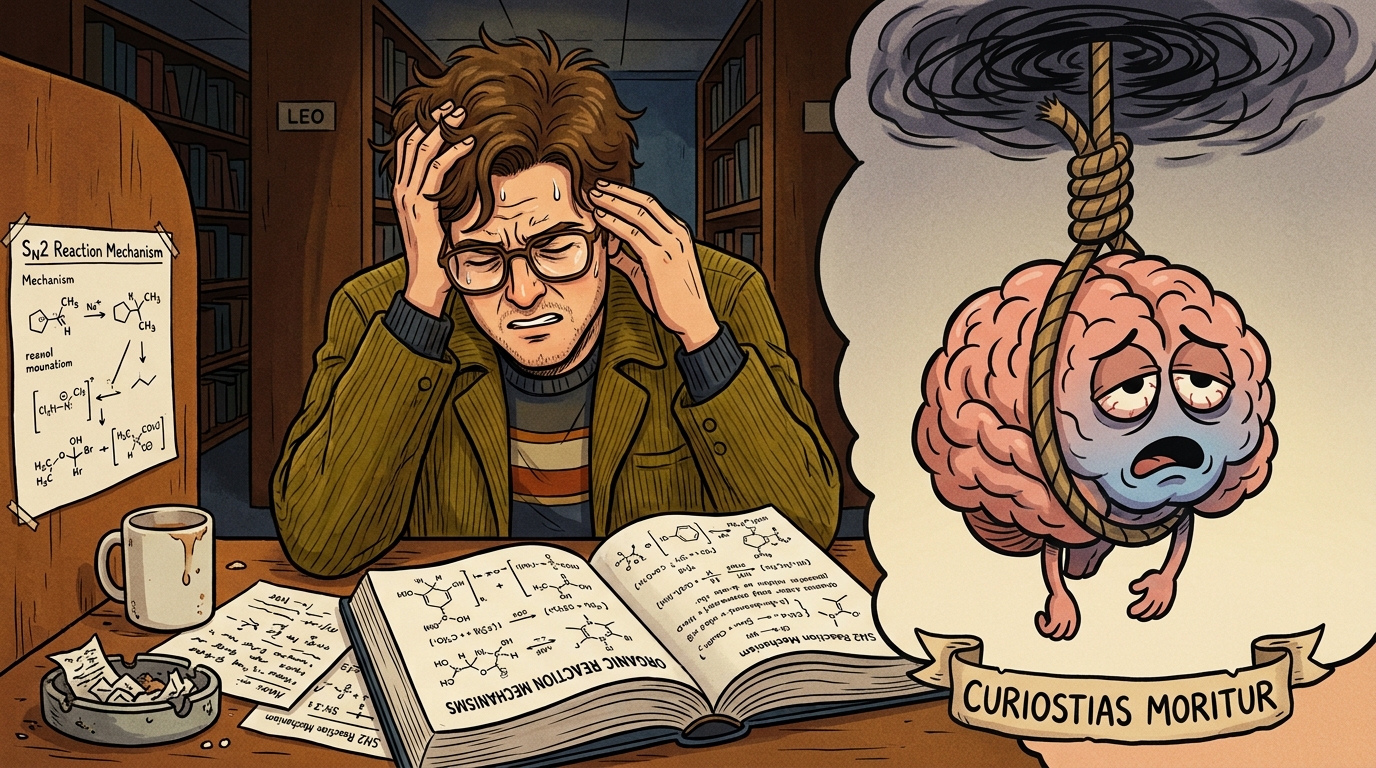
The Death of Curiosity
What do you want to do and why?
The school counselor used to fire this question point-blank at every senior student, alluding to the stage we were about to start.
It was her job after all, to correctly guide those who still didn’t know which path to choose.
It’s ironic to know that, even as adults, we’re still looking for the answer to this question, with the difference that, we don’t call them counselors, but psychologists, priests, mom or dad.
“I want to be a lawyer… doctor… engineer…” we would answer energetically. Uh-huh, and why? A notably more abstract question than the first, although often answered with nonchalance. Within the range of very good reasons from those who already knew it why, there were a couple of answers that, at least during my school days, were very common: to get a good job, to be someone in life.
I don’t need to emphasize how misguided this logic is if I ask myself the same thing 15 years later.
I think it’s a belief inherited from previous generations, for them the optimal path was to go to university.
Putting it in the context of another era, about 80 years ago, many were farmers, workers, or informal merchants who, when compared to the few professionals in practice back then, the conclusion is more than logical.
In other words, the poor work harder and earn less because they didn’t study.
For those on the other side of the street, these professionals that society called doctors, many times without having completed a doctorate, reached the same conclusion through different reasoning: “the pen weighs less than the shovel son” that was their saying.
I don’t mean to say that our parents’ logic about how to choose the easiest and most financially secure lifestyle is wrong, not at all, only that times have changed, they changed faster than grandma’s empanadas run out at a family gathering.
And that young heir to that mindset, who found himself caught in the crossfire of that transition, today clashes with the reality of the current system:
- He’s an aerospace engineer, but there are no rockets to build.
- Competitiveness in a market where semester after semester adds new competitors.
- Dealing with the broken salary expectations that don’t correlate with our academic effort.
- It’s more profitable to be an Uber driver than a lawyer or accountant.
So, if times have changed, why should we go to university?
The answer: not necessarily.
The previous question is deliberately poorly worded, a proper question should be: why should we learn?
This in itself is a more enriching question, and the answer is that we should never stop learning and feeling curious about discovering something new.
If I were to summarize this post in a single phrase, it would be precisely this: “Never stop learning”
Whether it’s at university, work, a YouTube tutorial, or life advice from a family member.
Where did the impulse that urged us to be explorers of knowledge go?
The death of curiosity
Back when I was in 9th grade of high school, my chemistry teacher talked about this phenomenon and used to say: “ahh but, whose fault is it? The parents’. Those who, tired of the persistent questions or not having the answer at the moment, would quiet the kid with a: OH COME ON, STOP ASKING SO MANY QUESTIONS! And just like that, we lost the desire to ask again.” We associate asking with something bad that should be avoided.
Perhaps true, at least partially. I have a complementary theory: it’s not our parents, it’s ourselves who silence our curiosity as we grow up.
I don’t know what happens internally during puberty, but at some point between childhood and adolescence, curiosity dies.
if I saw myself talking to a psychologist, their answer echoes in my mind like: “the mind is a fine mechanism that optimizes the use of energy, rational and curious thinking is equivalent to having a noisy V12 engine of a Camaro that drinks 20 liters of gas in 10 kilometers, when to get around you only need an electric skateboard; energy efficiency at its maximum expression”.
The phenomenon of the death of curiosity doesn’t occur alone either, but rather it’s catalyzed by the theft of attention. How can you focus for hours on an activity that deserves it when our attention window is programmed by an algorithm to no more than 1 minute? This isn’t something new, before social media there were other tools that captured our attention, only now it’s digital. A friend once told me: “you shouldn’t check social media right after waking up”. Why? I asked. “It’s bad,” she said. Now I understand why.
Adrenaline to revive it.
I don’t know at what point in society the belief that learning was studying for years took hold, we’re always learning. And often involuntarily: distinguishing cilantro from parsley is learning, researching what cilantro is used for and in what cases parsley is used is reinforcing that knowledge that leads you to discover new ingredients, experiment with recipes to create your own cooking style. If this weren’t about parsley and cilantro, this could be exactly the life story of a prominent chemist, a child who at some point wondered: why is salt salty and sugar sweet?
Learning by doing. It’s not enough to just ask yourself, you have to get your hands dirty, use our 5 senses consciously, if it’s a practical skill, patience and consistency. “I’m the best musician of all time”… said no one who ever took music seriously without practicing.
Reading never goes out of style, in this sense, “we do things for the wrong reasons,” a phrase that applies perfectly here. I don’t want to read for the vanity of appearing intellectual, or collect little medals like video game achievements. I read like a conversation with someone who has something interesting to say, without judging or agreeing or disagreeing with what is said, to widen my range of vision closed by the blinders of my own beliefs.
Learning something unknown is like traveling to a virgin and exotic country, being dazzled by something you had never before observed with attention, this applies to knowing things, places, and people, it’s not for nothing that each person is a world. I’m J and my mind is K saying: “Five hundred years ago everyone knew the Earth was flat. And fifteen minutes ago you knew people were alone on this planet. Imagine what you’ll know… tomorrow”.
Finally, I can only say there’s no single path. This is one of those situations where one person’s experience might not fit into another’s life. For me, reading leads me to philosophical debate with myself, and it’s so much information that I need to drain it somewhere. That’s how the idea for this blog was born, but I’d like to know: what feeds your curiosity?